
Prerequisites

Before you can configure and use LangGraph with Connect AI, you must first do the following:
  • Connect a data source to your Connect AI account. See Sources for more information.
  • Generate an OAuth JWT bearer token. Copy this down, as it acts as your password during authentication.
  • Obtain an OpenAI API key: https://platform.openai.com/.
  • Make sure you have Python >= 3.10 in order to install the LangChain and LangGraph packages.

Create the Python Files

1
Create a folder for LangGraph MCP.
2
Create a Python file within the folder called langraph.py.
3
Paste the following text into langraph.py. MCP_AUTH should be set to "OAUTH_JWT_TOKEN", not Base64-encoded EMAIL:PAT. Also, substitute Bearer for Basic in Authorization.
"""
Simple LangGraph + MCP + OpenAI Integration
Pure LangGraph implementation without LangChain
"""
import asyncio
from typing import Any
from langgraph.graph import StateGraph, START, END
from langgraph.prebuilt import create_react_agent
from langchain_mcp_adapters.client import MultiServerMCPClient
from langchain_openai import ChatOpenAI
from langchain_core.messages import BaseMessage, HumanMessage, AIMessage, ToolMessage
from typing_extensions import TypedDict, Annotated
import operator

class AgentState(TypedDict):
    """State for the LangGraph agent"""
    messages: Annotated[list[BaseMessage], operator.add]

async def main():
    # Configuration
    MCP_BASE_URL = "https://mcp.cloud.cdata.com/mcp"
    MCP_AUTH = "YOUR_BASE64_ENCODED_EMAIL:PAT"
    OPENAI_API_KEY = "YOUR_OPENAI_API_KEY"
    
    # Step 1: Connect to MCP server
    print("🔗 Connecting to MCP server...")
    mcp_client = MultiServerMCPClient(
        connections={
            "default": {
                "transport": "streamable_http",
                "url": MCP_BASE_URL,
                "headers": {"Authorization": f"Basic {MCP_AUTH}"} if MCP_AUTH else {},
            }
        }
    )
    
    # Step 2: Load all available tools from MCP
    print("📦 Loading MCP tools...")
    all_mcp_tools = await mcp_client.get_tools()
    tool_names = [tool.name for tool in all_mcp_tools]
    print(f"✅ Found {len(tool_names)} tools: {tool_names}\n")
    
    # Step 3: Initialize OpenAI LLM
    print("🤖 Initializing OpenAI LLM...")
    llm = ChatOpenAI(
        model="gpt-4o",
        temperature=0.2,
        api_key=OPENAI_API_KEY
    )
    
    # Step 4: Create LangGraph agent
    print("⚙️ Creating LangGraph agent...\n")
    agent = create_react_agent(llm, all_mcp_tools)
    
    # Step 5: Create the graph
    builder = StateGraph(AgentState)
    builder.add_node("agent", agent)
    builder.add_edge(START, "agent")
    builder.add_edge("agent", END)
    graph = builder.compile()
    
    # Step 6: Run agent with your query
    user_prompt = "List down the first record from the Activities table from ActCRM1"
    print(f"❓ User Query: {user_prompt}\n")
    print("🔄 Agent is thinking and using tools...\n")
    
    initial_state = {
        "messages": [HumanMessage(content=user_prompt)]
    }
    
    result = await graph.ainvoke(initial_state)
    
    # Step 7: Print final response
    final_response = result["messages"][-1].content
    print(f"✨ Agent Response:\n{final_response}")

if __name__ == "__main__":
    asyncio.run(main())

Install the LangChain and LangGraph Packages

Run the following command in your project root terminal:
pip install -U langgraph langchain langchain-openai langchain-mcp-adapters typing-extensions

Run the Python Script

1
When the installation finishes, run the following command to execute the script:
python langraph.py
2
The script discovers the Connect AI MCP tools needed for the LLM to query the connected data.
3
Supply a prompt for the agent. The agent provides a response.
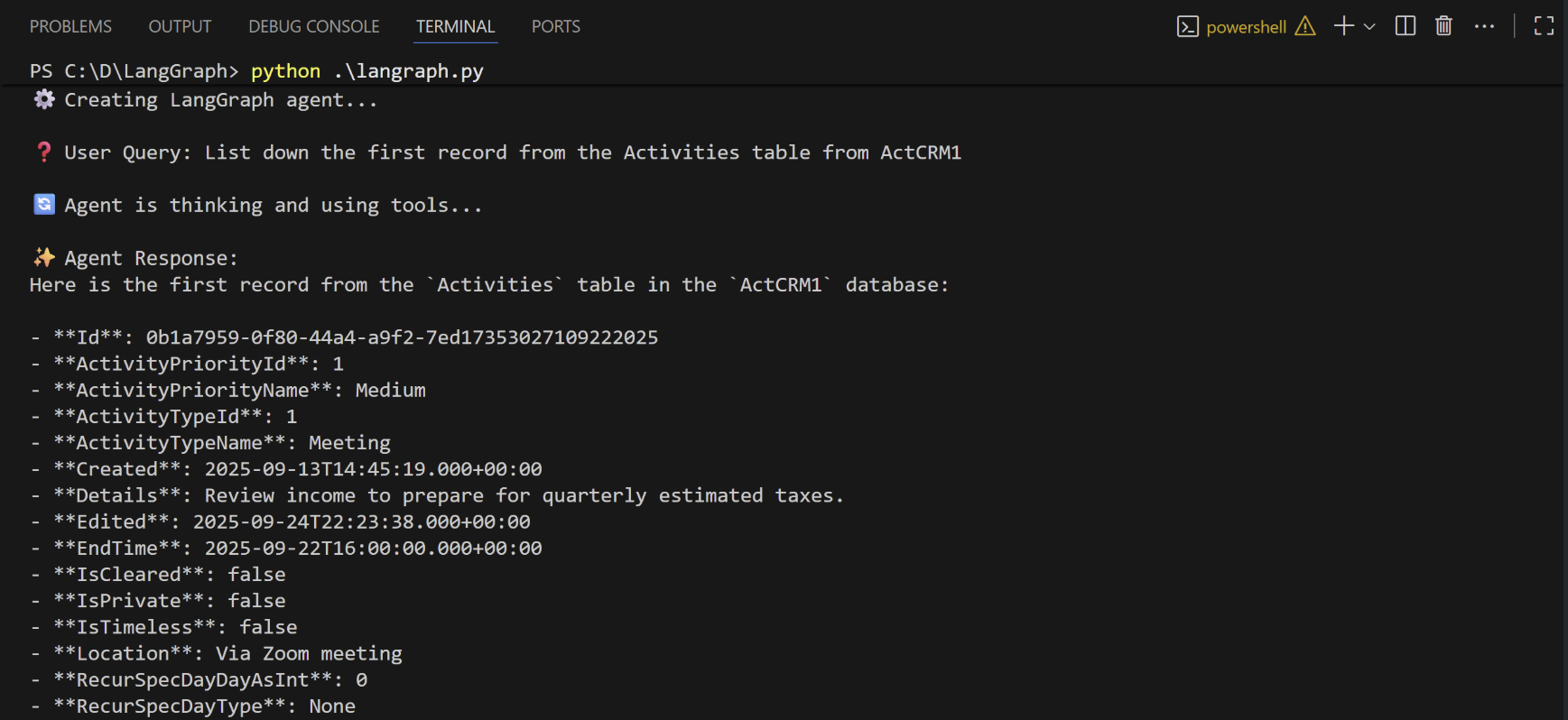
LangGraph Client Terminal